
Why connection matters more than any single tool
The textile industry already has the tools for a largely digital journey from fibre to finished garment. Most of them still sit in silos: the colour lab, the design studio, the pattern room and the cutting floor each work with their own files and their own version of the truth.
The real gain comes when those tools pass information to each other. A fabric scanned once can be seen in 3D, laid out in a cutting plan, costed and traced, all before a metre of cloth is cut. This post follows that thread stage by stage, and asks what happens when the designer can see the consequences of every decision while it is still easy to change.
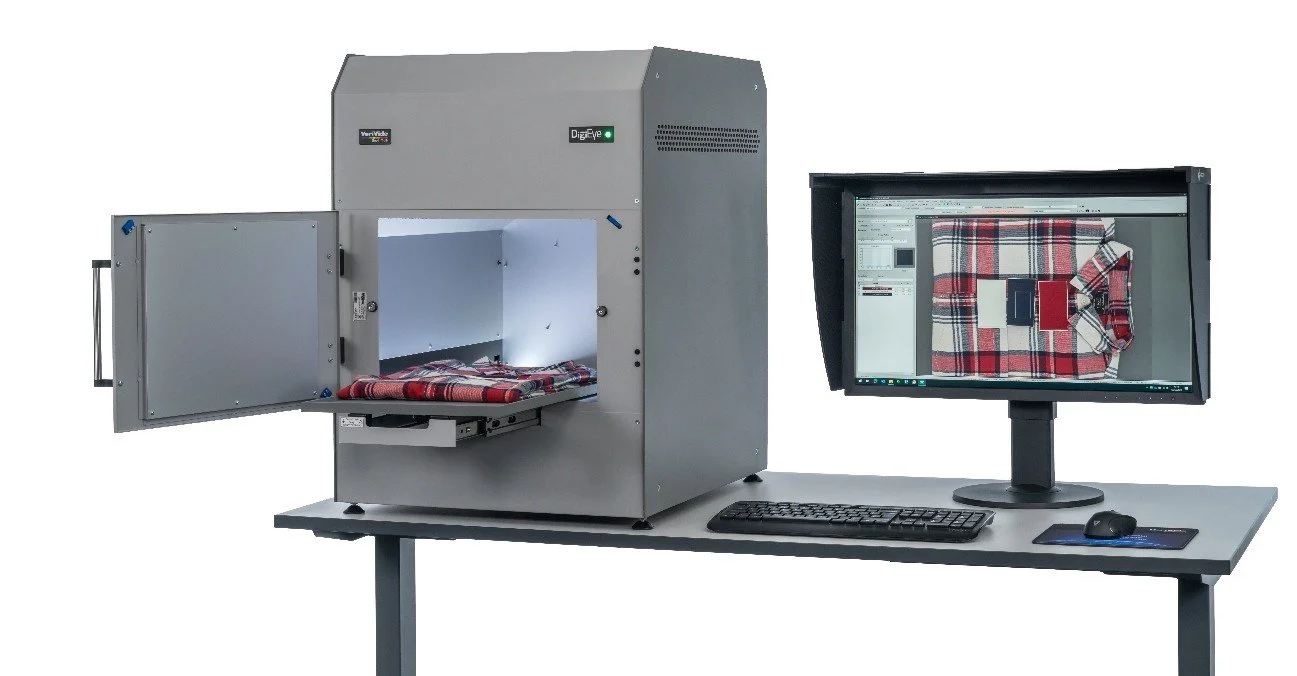
Image courtesy of Verivide Limited
Stage 1 - Capture: Making the Fabric Digital
Everything downstream depends on a faithful digital copy of the cloth. Get the colour or surface wrong here, and every render, approval and sample after it inherits the error.
• DigiEye from VeriVide combines non-contact colour measurement with calibrated digital imaging. Unlike a spectrophotometer, which reports an average colour across its aperture, it captures the whole sample as an image, including prints, multicolour yarns and surface texture.
• Spectrophotometers remain the reference for solid-shade colour standards and lab-dip approval.
• Material scanners such as Vizoo's xTex produce photorealistic digital materials, saved in the open U3M (Unified 3D Material) format for use in 3D design tools.
A good image is only half of a digital fabric. To drape, stretch and fold realistically in 3D, the software also needs the fabric's physical behaviour, and every 3D program asks for it in its own format. Testing laboratories such as Hohenstein, Intertek or Eurofins characterise the real fabric for this purpose. They measure weight, thickness, bending stiffness, stretch and drape (fold volume and shape on a drapemeter), then convert the results into parameters the 3D software can use.
The result is a digital fabric that carries accurate colour and appearance from imaging, and measured physical behaviour from the laboratory, ready to travel to the next stage.

Stage 2 - Design: Seeing the Garment Before it Exists
Once the fabric is digital, the designer can work with it in 3D. The scanned and characterised material is applied to 2D pattern pieces, stitched onto an avatar and simulated. The designer sees how the cloth hangs, how the print falls across seams and how the colour reads under different lighting. Several packages now do this, each with its own strengths:
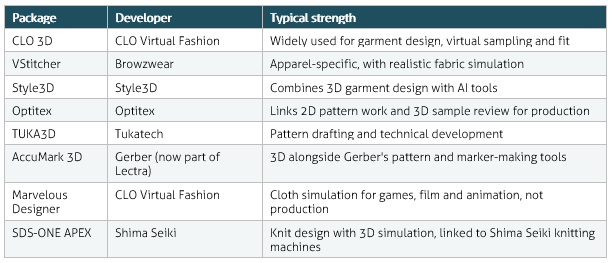
Each package asks for fabric data in its own format, which is why characterised parameters from labs like those mentioned above matter.
• 3D garment design replaces many rounds of physical sampling with virtual fittings and approvals.
• Weave and knit CAD lets the textile designer change the structure of the fabric itself, then pass the new design back into the 3D garment.
• AI-assisted design tools can generate print variations, colourways and early concepts, giving the designer more options to test virtually.
The important shift is that fabric and garment are no longer designed in separate rooms. A change to one is visible on the other within minutes.
Stage 3 - Plan: Designing Out Cutting Waste
This is where the connected workflow pays for itself. The same pattern pieces used in 3D can be laid out in a basic lay plan straight away. CLO's Nest Patterns feature, for example, arranges the pieces on a fabric width and reports the fabric consumed and the remnant as percentages.
The first lay plan rarely gives the best result, and the designer does not have to accept it. While the design is still digital, they can:
1. Adjust panel shapes so pieces interlock more closely.
2. Move seam lines or split large pieces into smaller ones that nest better.
3. Rethink trims, facings and small parts that leave awkward gaps.
4. Re-run the lay plan and compare the new waste figure, checking the 3D garment still looks and fits as intended.
How much difference can this make? Lectra reports that cutting-room waste typically runs at 10–20%, depending on garment complexity, pattern matching and marker efficiency. At the other end, Scott Wilton of Fabric Utilisation Ltd puts the best achievable figure at around 4%. Across a 10,000-metre fabric order, that gap is substantial:
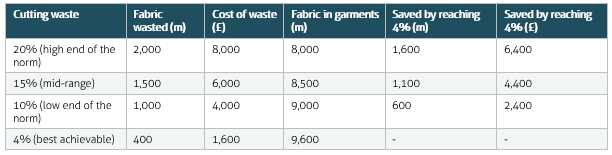
Costs are based on an illustrative fabric price of £4.00 per linear metre. Actual savings will vary with fabric price, width and garment type.
Even moving from the best of the typical range to the best achievable saves 600 metres, or £2,400, on every 10,000 metres bought. From the top of the range, the saving reaches 1,600 metres, or £6,400. That fibre has been grown or created, the fabric has already been knitted or woven, dyed, finished and shipped, so every metre saved also saves its water, energy and carbon.
Waste becomes a design decision made at the screen, not something the factory discovers afterwards. Dedicated marker-making systems from vendors such as Lectra, Gerber and Optitex then refine the production lay plan across sizes and fabric widths.
Stage 4 - Make: From File to Physical Product
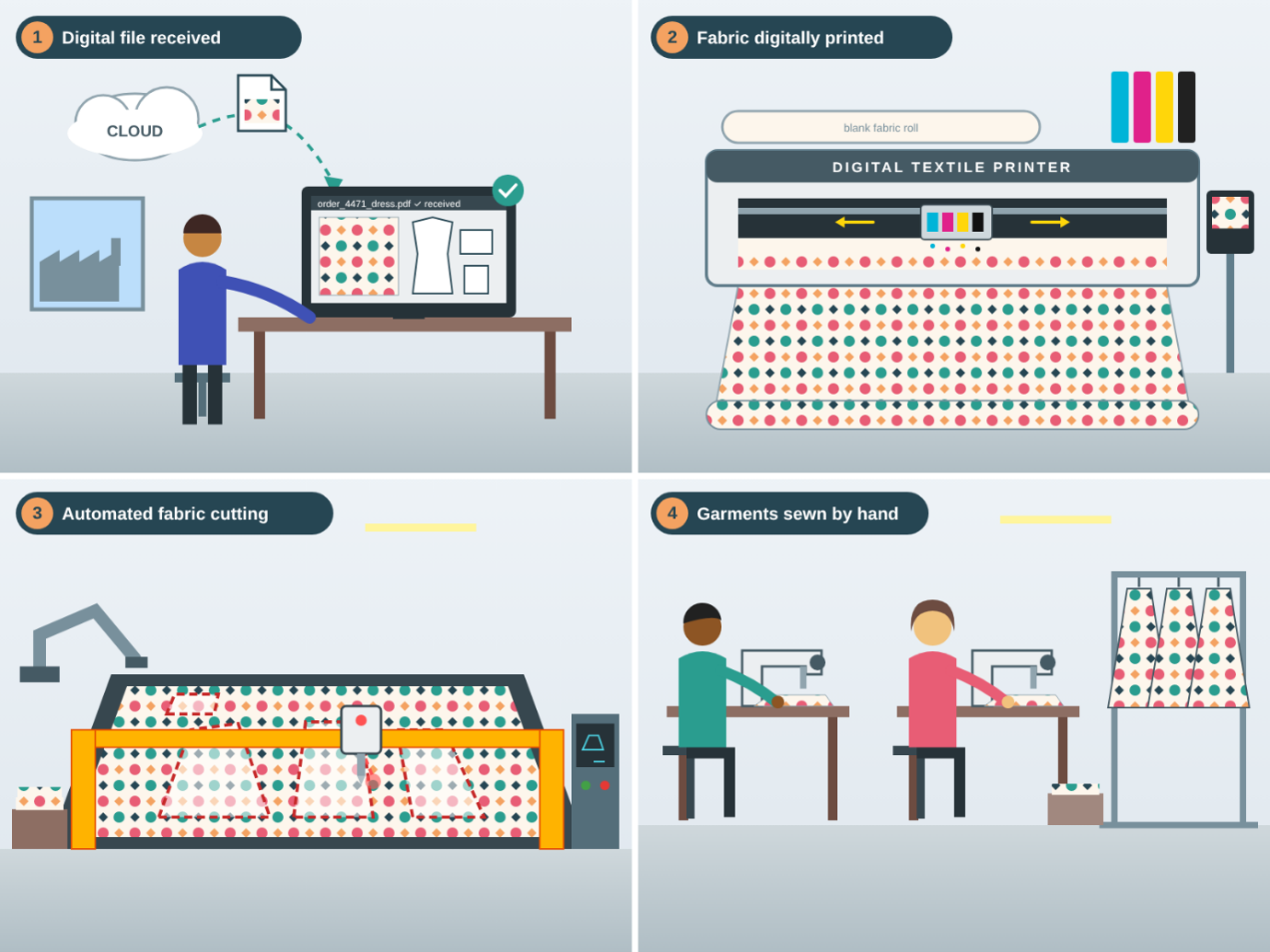
The digital thread continues onto the factory floor. The lay plan and pattern files that came out of design now drive the machines directly.
• Automated cutting systems read the marker file and cut multi-ply lays to it, so the efficiency won in design becomes the efficiency achieved on the floor.
• Digital textile printing prints the exact colourway approved in 3D, in the quantity needed, which reduces surplus stock. Engineered prints can be placed onto each pattern piece before cutting.
• Whole-garment knitting goes further still. Shima Seiki's WHOLEGARMENT machines knit a complete seam-free garment, and the company states that cut-loss "is entirely eliminated". For true knitwear, the lay plan problem disappears altogether.
The common factor is that each machine works from the data the designer created, not from a re-drawn or re-keyed copy.
Stage 5 - Connect and Trace: One Record From Scan to Shop
The stages above only join up if the data has somewhere to live. Two technologies hold the thread together.
• Product lifecycle management (PLM) systems keep the colour standard, digital material, 3D garment, pattern, lay plan and costing linked to a single product record. Change the fabric, and the cost and consumption update with it.
• Digital product passports (DPPs) take that record beyond the factory. Under the EU's Ecodesign for Sustainable Products Regulation (ESPR), textiles are a priority product group. The European Commission currently plans to adopt the textiles delegated act in Q4 2027, and describes that date as indicative. This does not mean that the design data is carried in the DPP but the fabric data and factory data will be
A business that already captures material, consumption and waste data digitally will find a passport far easier to fill. The data the designer used to reduce waste becomes the evidence that proves it and this helps with the EU green deal and future legislation.
The Team Behind the Thread
The designer sits at the centre of this workflow, but cannot make it work alone. Two technical roles make sure the digital garment is one that can actually be made, worn and sold.
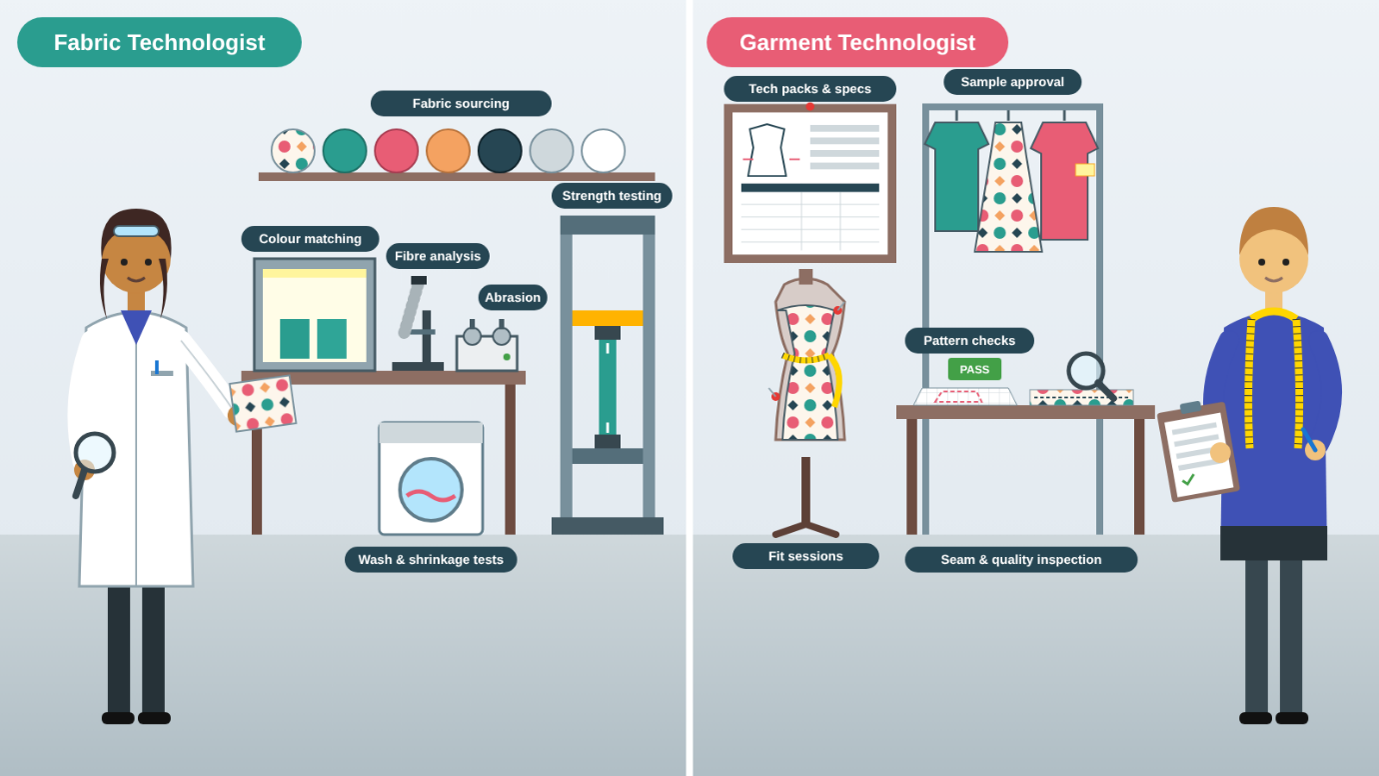
• The fabric technologist owns the truth about the material. They specify and approve the fabric, manage colour standards and lab dips, arrange testing to define physical characterisation, and check that the digital fabric behaves like the real one. If the fabric data is wrong, every 3D render and lay plan built on it is wrong too.
• The garment technologist owns the truth about construction and fit. They turn the design into accurate patterns, grading and specifications, run virtual and physical fittings, and judge whether a design change made to save fabric still fits, performs and can be sewn efficiently.
When the designer reworks a pattern to cut waste from 15% towards 4%, it is the garment technologist who confirms the fit still works and the fabric technologist who confirms the fabric will behave as simulated. The technology connects the data; these three roles connect the decisions.
It is important to note that these two roles together help to define the data that will be required in the digital product passports and will help with the inevitable durability requirements that are coming as part of the EU ESPR regulation
Fewer Parcels: What Changes at Each Sampling Stage
In a traditional workflow, every decision needs a physical object, and every physical object needs a courier. A connected workflow replaces most of those parcels with shared digital files, keeping physical samples for the points where they matter most.
The table below is an illustrative example for a single style, not measured data. Real numbers vary by product, supplier and retailer.
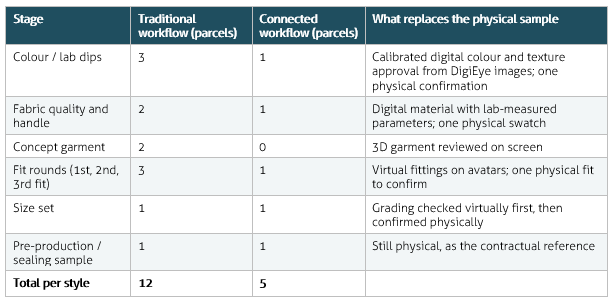
Illustrative figures only, to show the shape of the change.
On these assumptions, a range of 100 styles would move from about 1,200 parcels to about 500. Each parcel saved also removes days of transit from the critical path, along with the sample-making labour, fabric and carbon behind it.
Why Suppliers Who Work This Way as Standard Matter
The savings only appear when both sides of the relationship work digitally. If a retailer approves colour on screen but the mill can only send lab dips, or the 3D garment is built on fabric data the supplier never measured, the parcels come straight back.
Working with suppliers who do this as standard optimises the whole system for retail:
• Shared standards: calibrated colour, characterised fabrics and 3D files in agreed formats mean both parties are judging the same thing.
• Faster decisions: approvals happen in hours on screen rather than in weeks of shipping, shortening the critical path and allowing later, better-informed buying decisions.
• Less waste upstream and downstream: fewer sample garments, optimised lay plans and production closer to real demand.
• Ready-made content: the same 3D assets can support range reviews, line sheets and e-commerce imagery.
• Compliance built in: material, consumption and waste data already exist digitally when digital product passports arrive.
For a retailer, the question becomes less about which supplier is cheapest per unit, and more about which suppliers can join the digital thread.
The Designer at the Centre
None of these technologies is new on its own. What is changing is the ability to connect them, so that colour, appearance, fit, cost, waste and traceability all sit in front of the designer at the moment decisions are cheapest to change.
That puts the designer in a new position. They are no longer only responsible for how a product looks. Backed by the fabric technologist and the garment technologist, they can now shape how much fabric it uses, how efficiently it is made and how its story is told to the customer.
The question for most businesses is not whether these tools exist. It is whether their teams, systems and suppliers are set up to let the data flow between them. Where is the thread broken in your workflow?
Sources
• Textile World: Innovations in Testing & Quality Control (DigiEye)
• Textile World: BTMA at ITMA Asia + CITME 2025 (DigiEye)
• Hohenstein: Digital material parameters for a realistic 3D simulation
• Textile World: Hohenstein digital material libraries
• The Interline: Vizoo & CLO U3M plug-in
• Onbrand: CLO 3D alternatives
• Delogue: CLO vs Browzwear vs Optitex vs Style3D
• CLO Help Center: Nest Patterns
• Lectra: Material waste in fashion manufacturing
• Knitting Industry: Shima Seiki WHOLEGARMENT
• European Commission: DPP for textiles and apparel
• Cutting waste figure of around 4%: Scott Wilton, Fabric Utilisation Ltd (personal communication)
Please note: some of these images have been created using A.I. systems and are not meant to represent the actual work of a designer on digital clothing systems, others are reproduced thanks to the companies involved and they will always hold the rights to those images involved