
Policy Briefing For Parliament And Government
A cost-benefit case for procuring hospital, military and police/security uniforms that are both bought from and manufactured by UK-based businesses, with an outlook to wider corporate workwear

1. Executive Summary
In this paper, I set out the economic case for UK public bodies - principally the NHS, the Ministry of Defence (MOD) and police/security forces - to procure uniforms that are not only bought from UK-registered companies but physically manufactured in the UK, and I consider how the argument might later extend to wider corporate workwear.
I build the core case on four strands:
(a) direct jobs and wages retained in a UK textile and apparel manufacturing sector that has shrunk by roughly 90% in headcount since 1979
(b) a local-economy “multiplier” effect, whereby wages and supplier spending are re-spent in the UK economy rather than leaving it
(c) tax revenue and reduced demand on the benefits system from sustained onshore employment
(d) supply-chain resilience and national-security considerations, illustrated starkly by both the COVID-19 PPE experience and recent warnings about Chinese-manufactured military uniforms.
I weigh this against a real and often-cited cost premium for UK manufacture, the statutory duty on public bodies to secure value for money, and legal limits - under the Procurement Act 2023 and the UK's WTO Government Procurement Agreement (GPA) commitments - on directly excluding suppliers by nationality above certain contract-value thresholds.
I have concluded that a genuinely robust cost-benefit case for a specific procurement decision would need bespoke, uniform-sector-specific analysis that, as far as I have been able to establish, does not yet exist. In this paper I provide the framework, the best currently available figures (clearly sourced and dated), and a worked illustrative example - explicitly labelled as illustrative rather than empirical - to show how such an analysis should be structured, together with a list of the specific evidence gaps I believe should be closed before this is used to support a live procurement decision.
I also set out two further, related considerations.
First, I question whether the prevailing commercial model - a bulk order of finished uniforms held in a warehouse - is itself adding cost and waste, and I set out an alternative in which fabric stock is held centrally, cutting and sewing happen in small batches, and the incumbent tops up finished stock to an agreed level on an agreed timetable (Section 7).
Second, I examine whether an antimicrobial or antiviral treatment could turn NHS uniforms into genuine secondary protective clothing against community transmission, given that they are largely laundered at home and could in principle carry pathogens onto public transport (Section 8). Real antiviral fabric treatments claiming over 99% effectiveness against SARS-CoV-2 in laboratory tests do exist, and I set one out; but I have to say up front that the wider public health evidence on how SARS-CoV-2 actually spreads - chiefly by respiratory transmission, with fomites, and cloth in particular, judged a minor and unquantified route - means I cannot responsibly present that laboratory figure to Parliament as equivalent to a demonstrated population-level protective effect.

2. Purpose and Scope
I have written this paper to explore the cost-benefit to the UK economy of procuring uniforms that are both purchased from, and manufactured by, UK businesses - rather than from UK-registered companies that manufacture overseas. My focus is on hospital (NHS), military and police/security uniforms, with an eye to eventually extending the argument to corporate workwear generally.
I intend this paper as an evidence base for Members of Parliament and government departments considering public procurement policy in this area. I have tried to state the strongest evidence-based case for onshoring, while not suppressing the genuine counter-arguments and legal constraints that any procurement decision-maker would need to see.

3. What Public Bodies can and Cannot Do: the Policy and Legal Framework
3.1 The Procurement Act 2023 and the National Procurement Policy Statement
The Procurement Act 2023 is now the primary legislation governing UK public procurement. The Cabinet Office's National Procurement Policy Statement (NPPS), published 13 February 2025, sets the strategic priorities contracting authorities must have regard to. It emphasises using procurement to “kick start economic growth”, to maximise spend with small and medium-sized enterprises, to secure “high quality jobs that offer fair wages and good working conditions”, and to strengthen supply-chain resilience - but it contains no explicit “Buy British” instruction; its language is about fair competition, social and economic value, and value for money.
3.2 The WTO Government Procurement Agreement (GPA) constraint
The UK is an independent member of the WTO's plurilateral Government Procurement Agreement. Above the GPA's coverage thresholds, contracting authorities generally cannot discriminate against suppliers from other GPA parties on grounds of nationality, and cannot use “made in the UK” as an explicit award or exclusion criterion. This is why the Fashion Roundtable's July 2026 open letter to the Prime Minister specifically calls for procurement requirements to “specify where products are manufactured, not just where the winning company is registered” - a formulation designed to work through technical specifications and award criteria (e.g. lead-time, traceability, social value, sustainability) rather than a blanket nationality bar, which would likely fall foul of GPA obligations.
3.3 Below-threshold Flexibility
Below these thresholds, contracting authorities have materially more freedom: Welsh Government guidance on the Act, for example, confirms authorities can seek quotes from “targeted known suppliers only” or restrict competition to SMEs, though it explicitly warns that geography-based reservation should not be used for contracts of cross-border interest, including in relation to Northern Ireland. This suggests a practical lever: uniform contracts split into smaller lots below threshold could more readily favour identified UK manufacturers, while large national framework contracts (of the kind MOD and NHS typically run) sit above threshold and must rely on specification and award-criteria design rather than direct exclusion.
4. The Current Picture: Where are Public Sector Uniforms Actually Made?
4.1 Defence
Concerns about offshoring in defence uniform manufacture are well documented. Cooneen Defence, a Northern Ireland-based group describing itself as the largest supplier of uniforms to the MOD, held Army uniform contracts from 2018–2023 before reportedly shifting the majority of production to China. Separately, Source Tactical, an Israeli company that won the 2015 Virtus body-armour programme contract, reportedly subcontracted infrared-coating work to China. In July 2026, Sir Iain Duncan Smith, together with Luke de Pulford (Inter-Parliamentary Alliance on China) and Andrew Kinniburgh (Director General, Make UK Defence), publicly warned against outsourcing Army uniform production to China on national-security grounds, as approximately £526 million of new Army uniform contracts were being competed for; the same reporting cited claims that Chinese-made uniforms had failed to meet a 25-wash durability specification, lasting around five washes instead. British alternative suppliers named in this context include Toray Textiles Europe (Mansfield) and Carrington Textiles (Lancashire); Toray's Mansfield facility reportedly produces 20 million metres of fabric a year. In May 2026, Make UK Defence's Textile Working Group (hosted at Toray) warned separately of a skills crisis in cutting, sewing and technical-textile manufacture that could undermine the UK's ability to service defence contracts even where the political will exists to onshore them, this skills crisis is denied by Fashion Enter and the Leicester based factories that know that they have the staff and skills readily available.
4.2 The NHS
The clearest illustration of the risks of overseas sourcing in health uniforms and clothing is the COVID-19 personal protective equipment (PPE) experience, even though PPE is not uniform in the strict sense. The National Audit Office found that the Department of Health and Social Care (DHSC) spent approximately £12.3 billion on PPE during the pandemic (68% of total COVID procurement value), much of it sourced at speed from overseas manufacturers through a “high-priority lane” that approved referred suppliers at a far higher rate (around 9.5%) than the ordinary process (under 1%). DHSC's 2020/21 annual accounts were subsequently reported to show write-offs of the order of £8.7–£10 billion on PPE that proved defective, unsuitable, expired, or had collapsed in resale value - figures I have seen only through press reporting on the NAO/DHSC documents rather than by reading the full primary NAO report myself..
Separately, academic and industry commentary (e.g. University of Strathclyde research on “fast fashion, slow scrubs”) has raised sustainability and dignity concerns about current NHS scrubs sourcing, though this research did not surface a specific figure for what proportion of NHS uniform/scrubs spend goes overseas.
For balance it must be pointed out that during the Covid Pandemic, factories in Leicester produced PPE for the NHS and none if it was ever stated as having been an issue
4.3 Police and Security Services
Police uniform procurement in England and Wales is coordinated substantially through BlueLight Commercial, which runs national frameworks (for example, a framework for police uniform trousers was tendered via Find a Tender in 2024). A 2018 report by the CORE Coalition and the International Corporate Accountability Roundtable (ICAR), “Who Made Our Uniforms?”, examined public sector apparel procurement across the armed forces, prisons, emergency services, hospitals and London public transport; it found sourcing spread across China, Turkey, Indonesia, Bangladesh, India, Sri Lanka, Pakistan, Vietnam and Cambodia among others, but explicitly noted that no comprehensive single figure exists for total UK government apparel spend, and that it could not quantify the domestic/overseas split because a meaningful number of contractors disclosed no sourcing information at all. That transparency gap appears, as far as I can establish, to remain largely unresolved: I found no more recent, more complete UK-wide dataset.
5. The State of UK Textile and Apparel Manufacturing
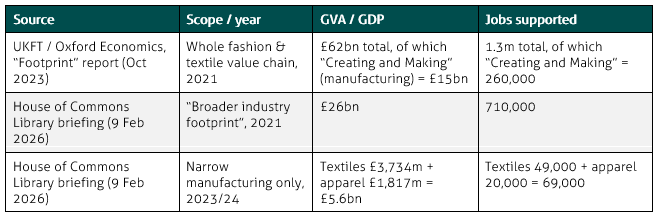
Any onshoring case has to be assessed against the real, much-reduced size of the UK manufacturing base. The House of Commons Library (9 February 2026) records 49,000 textile-manufacturing jobs and 20,000 apparel-manufacturing jobs in the UK in 2024 (0.16% and 0.06% of total UK employment respectively), concentrated in the North West and Yorkshire (textiles) and the East Midlands (apparel), with textile manufacturing GVA of £3,734 million and apparel manufacturing GVA of £1,817 million in 2023/24. The 2018 CORE/ICAR report separately cites a fall in UK textile manufacturing employment of 90.1%, from 851,000 to 85,000 jobs, between 1979 and 2013 - a different, older figure using different sector boundaries, but directionally consistent with a long-term structural decline.
Wider “industry footprint” figures, which include design, retail, distribution and aftercare alongside manufacturing, are considerably larger - but different sources give materially different numbers depending on scope and year, and it is important not to conflate them when building a manufacturing-specific case. Table 1 sets these out side by side.
6. The Economic Case for Keeping Uniform Manufacture in the UK
6.1 Direct Jobs, Wages and the Local Economy Multiplier
The most intuitive benefit is direct: money spent on UK-manufactured uniforms pays UK wages, UK business rates and UK supplier invoices, rather than flowing largely to an overseas factory with only a UK company's margin, design and logistics function remaining onshore. Economists commonly describe the knock-on effect of this - as recipients of that income spend and re-spend it within the UK - as a “multiplier”. The New Economics Foundation's LM3 (“Local Multiplier 3”) method is a widely used, practical way of measuring this at organisational or contract level: it sums income (Round 1), the local spending of that income by the recipient organisation (Round 2), and the further local re-spending by those recipients (Round 3), then divides the total by Round 1.
In NEF's own published case studies this produces multipliers such as 1.87 for a community outdoors organisation in Appleby (“every £10 ... generates £18.70 for the ... economy”), 1.67 for a Sheffield social enterprise, and a comparison in Tayside where locally-rooted B&Bs generated a 2.20 multiplier versus 1.38 for larger hotels, illustrating that how locally money is spent matters as much as how much is spent.
6.2 Tax Revenue and the Fiscal Case
The House of Commons Library briefing cites an industry claim that “removal of barriers to public sector procurement of textiles could increase GDP by £3.1 billion, support an additional 64,000 jobs” and generate £1.2 billion in additional tax revenues. This is a striking figure and it appears in an official parliamentary briefing, which gives it more standing than an advocacy claim alone - but the briefing is reporting an industry-sourced estimate rather than an independent government costing, and I was not able to trace the underlying model (assumptions on which barriers are removed, over what timeframe, or which uniform categories are included). It should be treated as an industry estimate worth citing and interrogating, not as a validated Treasury or OBR figure. In the current case we are not looking to cite this figure, we are looking at supporting current factories who employ people already. Fashion Enter already train people to perform the cut and sew operations in factories and have close links to the factories ibn Leicester and getting procurement through to them will support UK jobs along the whole value chain.

6.3 Industrial Resilience, Skills and National Security
Beyond pounds and jobs, three linked and largely qualitative benefits recur across the sources:
first, sovereign capability - the ability to scale up production of uniforms and protective equipment quickly in a crisis, which the COVID-19 PPE experience showed the UK lacked;
second, a functioning skills pipeline in cutting, sewing and technical textiles, which Make UK Defence's Textile Working Group warned in May 2026 is now at risk of being lost within a generation if defence work continues to move overseas;
third, security of supply for sensitive defence and policing equipment, where the July 2026 warnings about Chinese-manufactured Army uniforms (both on durability grounds and on forced-labour and surveillance concerns) illustrate a risk that is specific to defence and difficult to monetise but easy to justify politically.
6.4 Avoiding a Repeat of the PPE Experience
The PPE write-offs discussed in Section 4.2 are the strongest single “cost of the status quo” data point found in this research, even though PPE procurement (rushed, pandemic-era, high-priority-lane) is not directly comparable to steady-state uniform contracts. They are best used as an illustration of the tail-risk of overseas-dependent, opaque supply chains under stress, not as a routine cost saving that recurring UK uniform manufacture would automatically deliver.
7. Rethinking the Commercial Model: Fabric Stock, Small Batches and Vendor-Managed Top-Ups
Beyond the manufacturing-location question, I want to raise a separate but related idea: the way public bodies currently buy and hold uniform stock may itself be adding unnecessary cost, waste and risk - and changing it could make UK manufacture more, not less, viable.
7.1 The Current Model: Bulk Ordering and Centralised Stockholding
As I understand it, the prevailing model for large public sector uniform contracts is to place a bulk order for a large volume of finished garments against a multi-year framework, which is then held either at the incumbent contractor's own premises or in a government-controlled facility (for example, MOD stores), pending issue to individual service personnel or staff as needed.
This bulk-and-store model carries three costs that are easy to overlook in a simple price-per-unit comparison.
First, it ties up working capital in finished-goods inventory long before it is issued or worn.
Second, it creates a real risk of obsolescence: if a specification, sizing standard, badge or branding changes mid-contract, a large finished-stock holding can be stranded and written off - the kind of risk that obsolescence-management literature in defence and aerospace procurement more broadly treats as a recurring, costly problem.
Third, and most relevant to the argument in Section 6.3, a single large bulk order followed by years of no further orders does little to sustain a UK manufacturer's workforce and machinery continuously - it is a poor way to keep a skills pipeline “warm”, compared with steady, smaller-volume production.
As a note to this, Ramco UK was awarded the UK-wide Defence Equipment Sales Authority contract in March 2024 for "collection, marketing, sale and disposal of commercial assets," and its own material states it processes approximately 6,500 pallets of clothing and textiles a year from UK military sites, sold on to trade and government customers worldwide.
As taxpayers we have to wonder if these are new clothing and if so why are they sold? Our proposals would see this stop.
I found at least 15 websites selling new, unissued military clothing direct to the public. If this is actual deadstock that cannot be worn by British service personnel then we would ask why hasn’t this been reworked into other items that could be used.
7.2 An Alternative: Hold Fabric, Cut and Make in Small Batches, and Top Up to an Agreed Level
I would ask the Government to consider an alternative commercial model: hold the bulk safety stock as unfinished fabric rather than finished garments, contract with the UK manufacturer to cut, make and trim in smaller batches against a rolling forecast, and have the incumbent maintain a smaller finished-stock holding in the warehouse, topped up on an agreed timetable to an agreed minimum-and-maximum level.
This is not a novel idea in supply chain management generally, even if I found no evidence it has been applied to UK public sector uniforms specifically. It combines two established approaches. The first is “postponement”, long used in the textile and apparel industry, where final processing (dyeing, cutting, printing) is delayed until closer to actual demand so that generic, unfinished stock can be held cheaply and converted quickly once real requirements are known. The second is Vendor-Managed Inventory (VMI), a model in which the supplier - not the buyer - monitors stock levels at the buyer's premises and automatically replenishes them to a pre-agreed minimum and maximum band under a formal contract, rather than the buyer placing ad hoc repeat orders. A closely related manufacturing philosophy, Quick Response Manufacturing (QRM), explicitly argues that running smaller batches at slightly below full capacity reduces both inventory and lead time compared with the traditional approach of maximising batch size and machine utilisation.
7.3 Why I Believe this Would Strengthen, not Weaken, the Case for UK Manufacture
Reducing finished-stock holding should lower warehousing and working-capital costs to the taxpayer, and it should reduce the write-off risk when specifications change, since fabric is more generic and stable than a finished, badged garment. Just as importantly for the argument in this paper, a manufacturer running a continuous, smaller-batch production schedule keeps cutting, sewing and technical-textile jobs and machinery active between the large periodic tenders that currently characterise this market - directly addressing the skills-pipeline concern that Make UK Defence raised in May 2026 (Section 6.3). It should also improve crisis responsiveness: a manufacturer already running live production lines, with a stock of fabric ready to be cut, should be able to scale up faster in an emergency than one that last produced a large order some years earlier and has since moved on to other work - precisely the capability gap the COVID-19 PPE experience exposed.

8. NHS Uniforms as Secondary Protective Equipment: Antimicrobial Treatment and Home Laundering
Since NHS uniforms, particularly nurses' uniforms, are generally laundered at home, a nurse who has been in clinical contact could carry pathogens on that uniform during the course of their work. This could act as a danger to the healthcare professionals and the patients and, when they are travelling home, the wider public. Nurses have disposable PPE, however their uniform is always on under that, if there was some form of cross contamination then the uniform would be the most likely place for it to fall. We would propose that uniforms are treated with an antimicrobial, antibacterial compound, we know of a UK manufactured one that has been tested by the UK government during the pandemic and achieved a result of being >99% effective against SARS-COV -19. This would help the UK in ensuring the continued health of their healthcare professionals during a pandemic, it would be a secondary layer to help prevent our healthcare professionals from becoming sick themselves..
8.1 The Current Policy, and Why it is Contested
NHS England's guidance for employers (updated 2 April 2020) permits home laundering of uniforms and workwear. It states that washing with detergent at 60°C for ten minutes removes nearly all micro-organisms, that even 30°C with detergent eliminates MRSA and most other organisms, and - notably - that “there is little effective difference between domestic and commercial laundering” in removing contamination. That guidance was, however, publicly challenged at the time by Dr Katie Laird, Reader in Microbiology at De Montfort University, who advised Government against it: her own survey of 265 hospital staff found 44% laundered their uniforms below 60°C, domestic machines do not segregate soiled and clean laundry the way industrial ones do, and she recommended in-house or industrial laundering instead. This suggests the weak point in the current system may be less about the fabric itself, and more about whether the washing conditions the guidance assumes are actually met at home - which, by its nature, nobody verifies. With this specifically in mind, the addition of the agents could help to reduce the risks that are currently there.
8.2 The Link Back to the Manufacturing and Stock-Holding Case
If Government did move toward centralised or industrial laundering of NHS uniforms - ending routine home laundering, and applying an antimicrobial or antiviral treatment at that stage - it would mean NHS staff need more sets of uniform in circulation at any one time, so that one set can always be at the laundry. That additional stock requirement is exactly the kind of problem the small-batch, vendor-managed stock model I set out in Section 7 is suited to: it would let a UK manufacturer supply the extra volume through a steady, smaller-batch flow rather than a single further bulk order. I have not attempted to cost either the additional laundering infrastructure or the extra uniform sets this would require, and I flag that as a further piece of work needed before this becomes a costed proposal.

9. Counter-Considerations: the Case has Real Costs and Legal Limits
An even-handed briefing has to set out the arguments against as clearly as the arguments for.
Cost premium: UK manufacture is genuinely more expensive on a like-for-like unit basis. Make It British, an industry advocacy site publishes a worked example for a t-shirt in which Far East manufacturing costs £4.24 against £8.85 in the UK - a 109% premium on manufacturing cost alone - but argues that once shipping, duties, agent fees and lower UK sell-through-driven markdown losses are factored in, the effective gap narrows to around 26%. This is a single illustrative example for one garment type from an advocacy source; I found no independent, uniform-sector-specific cost study, and the true premium will vary substantially by garment complexity, fabric, and order volume. With this in mind, it can be successfully argued that a centralised purchasing policy of these uniforms would be the best approach, larger orders tend to have more leverage with suppliers because some of the setup costs are amortised over a greater number of garments.
Legal and value-for-money constraints: as set out in Section 3, above-threshold contracts cannot lawfully exclude suppliers purely on the basis of overseas manufacture, and every contracting authority remains under a statutory duty to secure value for money - a higher unit cost has to be justified against demonstrable social, economic or resilience value, not assumed.
Budget impact: NHS trusts, police forces and the MOD are all operating under sustained budget pressure; a genuine unit-cost premium, even a modest one, has to be funded from somewhere, and any business case needs to show either where savings are found elsewhere or why the wider social/economic return justifies the extra spend to the specific budget holder - who does not automatically capture the tax and multiplier benefits that accrue economy-wide.
10. Illustrative Cost-Benefit Framework
(a worked example, not a forecast)
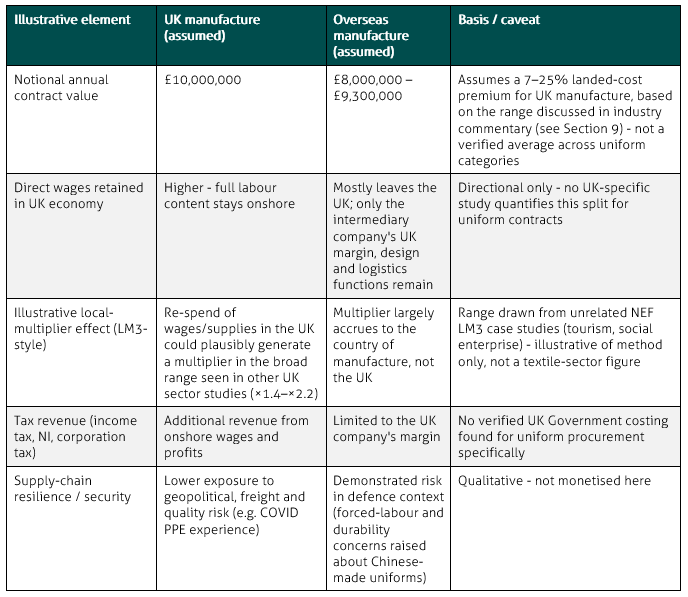
The table below shows the shape I believe a proper cost-benefit analysis should take, applied to a notional £10 million annual uniform contract. Every figure in the “UK manufacture” and “Overseas manufacture” columns is illustrative and clearly labelled as an assumption, not a researched fact - my purpose is to demonstrate the method so that officials, or a commissioned economist, can substitute verified, contract-specific figures.
Even on illustrative figures, the direction of the argument is visible: a UK manufacturing premium of, say, £700,000–£2,000,000 a year on a £10 million contract has to be weighed against retained wages, a plausible (but unverified for this sector) local multiplier, additional tax take, and reduced tail-risk - none of which are captured in a simple lowest-price tender comparison. Whether that weighing favours UK manufacture depends entirely on the real, contract-specific numbers, which I could not source with confidence and which I flag below as the priority for further work.
11. Evidence Gaps I Believe Should be Closed Before This Informs a Live Decision
In line with the strict evidence standard I have applied throughout, I believe the following gaps should be closed, or explicitly acknowledged as assumptions, before this analysis is used to support an actual procurement decision:
• No verified, current, cross-government total for UK public sector uniform spend across NHS, MOD and police/security exists in the public domain; the most systematic attempt I found (CORE/ICAR, 2018) is now several years old and says explicitly that it could not produce this figure.
• No published fiscal or local-economy multiplier specific to UK uniform or textile manufacturing exists, as far as I can establish; the LM3 examples I use here are from unrelated sectors and only illustrate method and order of magnitude.
• The industry-cited £3.1bn GDP / 64,000 jobs / £1.2bn tax claim (Section 6.2) needs its underlying methodology and assumptions traced to the original modelling, ideally corroborated by an independent body such as the OBR, HMT or ONS, before I would use it as a headline number.
• The £62bn/1.3m-jobs and £26bn/710,000-jobs figures for the wider fashion-and-textile footprint (Table 1) are inconsistent between an industry source and an official parliamentary briefing for the same reference year; I recommend this is reconciled directly with UKFT or the House of Commons Library.
• I was not able to confirm the precise 2026 Procurement Act/GPA threshold values in force today (Section 3.2); these should be checked against the current Procurement Policy Notes.
• I sourced the PPE write-off figures (Section 4.2) through press reporting on NAO/DHSC documents, not by reading the primary NAO report directly; I recommend the exact figures and their breakdown are verified against the NAO's own publications.
• My cost-premium evidence (Section 9) rests on a single industry-advocacy worked example for one garment type; an independent, uniform-specific costing - ideally commissioned from several current UK manufacturers, e.g. Cooneen, Toray, Carrington, Fox Brothers - would substantially strengthen the case.
• No current UK public body appears to publish how much finished uniform stock it holds, where, or at what warehousing cost (Section 7.1); without this baseline, I cannot quantify what a small-batch, vendor-managed alternative would actually save.
• I found no UK or NHS-specific trial of antimicrobial uniform fabric or of centralised NHS uniform laundering (Section 8); the trial evidence I did find is US-based, dates from 2013–2017, and is mixed at best - two RCTs found no benefit from antimicrobial-treated scrub fabric, while one non-randomised study found a real benefit from a silver treatment applied during industrial laundering, a materially different intervention.
12. My Recommendations to Government
On the evidence gathered, I recommend that the Government:
• commission a bespoke local-multiplier or ONS input-output-based economic impact study for the specific uniform-manufacturing supply chain(s) in scope, rather than relying on figures from other sectors; I believe that this is being presented at the Manchester made event in October 2026
• compile an authoritative, current total for UK public sector uniform spend, its manufacturing-location split, and current finished-stock holdings and warehousing costs, working with BlueLight Commercial, MOD Defence Equipment & Support, and NHS Supply Chain, since none of this currently exists publicly;
• frame any procurement change around lawful levers - technical specification, traceability requirements, award criteria on resilience, social value and lead-time - rather than a direct nationality-based exclusion, to stay within Procurement Act 2023 and WTO GPA obligations;
• sequence the policy ask realistically, prioritising defence and NHS uniform contracts first (as the Fashion Roundtable's July 2026 letter to the Prime Minister recommends), using below-GPA-threshold contracts and smaller lots to help give work sooner rather than later
• run a pilot of the fabric-stock, small-batch, vendor-managed replenishment model set out in Section 7 on one current framework (for example, NHS scrubs or a police uniform lot), comparing warehousing cost, wastage and lead-time against the existing bulk-order model before considering wider adoption;
• treat the COVID-19 PPE experience as the illustrative resilience case study that it is, while verifying its figures directly against the National Audit Office's own reports before quoting them further.
I would welcome the opportunity to discuss this paper with any Member of Parliament, committee or official who would like to take this further; I can be reached at niall@theknowledgenexus.co.uk.
13. References
I accessed all sources by web search on 10 September 2026. Where a figure originates from an industry-advocacy body rather than an official or academic source, I have noted this in the text above; the same is true here where relevant.
1. Mahmood, S. and Jozepa, I. (2026) Onshoring in the fashion and textiles industry, House of Commons Library, 9 February 2026.
2. Fashion Roundtable (2026) Public Procurement is the Lever We Are Not Pulling in the UK: open letter to the Prime Minister, July 2026.
3. FashionUnited (2026) UK government urged to prioritise domestic textile manufacturing through public procurement, 4 August 2026.
4. AOL News (2026) Make military uniforms in Britain or risk security concerns, MoD warned, 4 July 2026.
5. Specialised Covers (2026) The UK Can't Afford to Lose Its Textile Skills, and the Defence Sector Knows It, 21 May 2026 (reporting on the Make UK Defence Textile Working Group).
6. Cooneen Group, Cooneen Defence, company website, accessed September 2026.
7. CORE Coalition and International Corporate Accountability Roundtable (2018) Who Made Our Uniforms? U.K. Public Sector Apparel Procurement, September 2018.
8. National Audit Office (2020) Investigation into government procurement during the COVID-19 pandemic, 26 November 2020.
9. National Audit Office (2022) Investigation into the management of PPE contracts, 30 March 2022; write-off figures as reported via Business Matters, 2 February 2022 - verify against the primary NAO report before external use.
10. Cabinet Office (2025) National Procurement Policy Statement, 13 February 2025.
11. Welsh Government, Procurement Act 2023 guidance: below-threshold contracts.
12. UK Public General Acts, Procurement Act 2023, Schedule 1 (threshold amounts, as at commencement 2024); see also The Procurement Act 2023 (Threshold Amounts) (Amendment) Regulations 2025 for subsequent changes not independently confirmed here.
13. World Trade Organization, Government Procurement Agreement – overview.
14. UKFT / Oxford Economics (2023) The Fashion & Textile Industry's Footprint in the UK – Executive Summary, October 2023.
15. New Economics Foundation (2002) The Money Trail: Measuring your impact on the local economy using LM3.
16. Make it British, Is making clothing in the UK really more expensive? (industry commentary, not an independent or academic source).
17. ABC News / Al Jazeera / CNN (2026) reporting on Andy Burnham becoming UK Prime Minister, July 2026 - cited for current political context only, via web search on 10 September 2026.
18. NHS England (2020) Uniforms and workwear: guidance for NHS employers, updated 2 April 2020.
19. De Montfort University (2020) Scientists advise Government that no healthcare uniforms should be washed at home during COVID-19 crisis (Dr Katie Laird), 23 April 2020.
20. Burden, M. et al. (2013) “Bacterial contamination of healthcare workers' uniforms: a randomized controlled trial of antimicrobial scrubs”, Journal of Hospital Medicine; summary accessed via CDC Stacks.
21. Anderson, D.J. et al. (2017) “The Antimicrobial Scrub Contamination and Transmission (ASCOT) Trial”, Infection Control & Hospital Epidemiology; summary accessed via HFM Magazine and indexed on Semantic Scholar - I have not read the full primary journal article.
22. American Journal of Infection Control (2016) Reduction in bacterial contamination of hospital textiles by a novel silver-based laundry treatment, 30 August 2016.
23. Wikipedia, Quick response manufacturing - a tertiary source, useful for the general concept; I recommend citing Suri, R.'s original work directly in any published version of this paper.
24. SAP, What is Vendor Managed Inventory (VMI)? - a vendor explainer, used here only for the general definition of VMI.
25. HeiQ AG (2020) HeiQ Viroblock Tested Successfully Against Virus That Causes COVID-19, press release, 8 June 2020; laboratory testing by the Peter Doherty Institute for Infection and Immunity.
26. Owen, L. and Laird, K. (2020) The role of textiles as fomites in the healthcare environment: a review of the infection control risk, PeerJ, 8:e9790.
27. Australian Nursing and Midwifery Federation (2020) Evidence brief: COVID-19 and laundering of healthcare worker uniforms, 16 July 2020.
28. US Centers for Disease Control and Prevention (2021) Science Brief: SARS-CoV-2 and Surface (Fomite) Transmission for Indoor Community Environments, 5 April 2021.