

PPWR, the Packaging and Packaging Waste Regulation, is the EU law that sets rules for all packaging sold in the EU, covering what it is made of and how it is labelled, recycled and reused. Its official name is Regulation (EU) 2025/40. It has applied since 12 August 2026 to every business placing packaging on the EU market, including UK brands that sell into the EU.
PPWR replaces the EU Packaging Directive (94/62/EC). It applies directly in every EU country, so there is no wait for national laws. It covers packaging placed on the EU market wherever that packaging was made. UK fashion and home brands that sell to EU customers are affected, whether they sell through retailers, marketplaces or their own websites.
The rules cover your product packaging and also your shipping cartons, mailers, polybags and transit packaging. Some items are judged case by case, so it is worth checking what counts as packaging in your range.

PPWR applies now - the biggest design changes land in 2030.
PPWR key dates · 2025 to 2040
• 11 February 2025: PPWR entered into force.
• 12 August 2026: PPWR applies, including the substance limits, recyclability and compliance documentation.
• 12 August 2028: Harmonised EU packaging labels.
• 12 February 2029: Label for reusable packaging.
• 1 January 2030: Design-for-recycling grades, the 50% empty-space limit, recycled content targets for plastic packaging and bans on some single-use formats.
• 2040: Higher recycled content and reuse targets.
Some later dates may move if the EU's detailed rules arrive late. For example, the labelling date moves back if the implementing acts are delayed.
What does PPWR require?
The rules fall into six areas. Some apply now and others come in between 2028 and 2040.
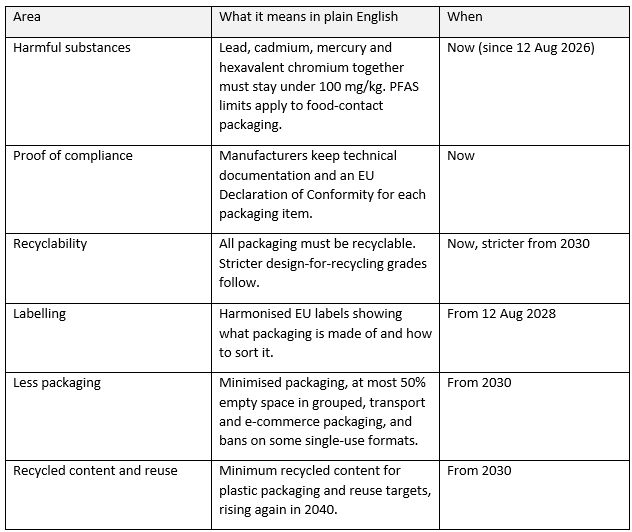
Producers must also register, report and pay for packaging waste (Extended Producer Responsibility, or EPR) in each EU country where they first make packaging available.
What are the main PPWR challenges for brands?
The law is in force but the detail is still arriving, so most brands are working with some uncertainty.
• The rulebook is still being written. About 30 further acts, standards and guidance documents are still to come, and EU countries may interpret the rules differently.
• You need to know your packaging. Compliance starts with an inventory of every packaging item by SKU, including what it is made of and who supplies it.
• You depend on suppliers. You need test results and declarations from suppliers, and test methods for some substances, such as PFAS, are not yet harmonised.
• The paperwork is substantial. Manufacturers need technical documentation and a Declaration of Conformity for each packaging item.
• Changing packaging takes time. Redesigning coatings, laminates or closures means requalifying suppliers, so the 2030 deadlines are closer than they look.
• EPR differs by country. Registration, reporting and fees are handled separately in each EU country you sell into.
Authorities have been asked to start with warnings rather than recalls, but that guidance does not bind them. National market surveillance authorities and customs enforce the rules.
How Can The Knowledge Nexus Help With PPWR Compliance?
The Knowledge Nexus gives fashion and home brands practical PPWR and EPR support: two industry specialists and one point of contact.
• Packaging review. We map your packaging by SKU and show where you stand against today's rules and the 2030 deadlines.
• Supplier evidence. We work out what to ask your suppliers for, then gather and check their declarations and test reports.
• Compliance documentation. We help you put together technical files, Declarations of Conformity and supplier manuals.
• EPR declarations. We help with registration and reporting so you meet your producer obligations.
• Packaging and product claims. We check that recyclability and sustainability claims on packs and websites can be backed up.
• Training. We give your team a clear understanding of PPWR so they can manage it day to day.
We can work with you for a few hours or days a month, or on a larger fixed-term project.
PPWR FAQs
Does PPWR apply to UK businesses?
Yes, if you sell into the EU. PPWR covers all packaging placed on the EU market, wherever the business is based or the packaging was made. It does not apply to sales within Great Britain, which follow UK packaging rules instead.
Is PPWR the same as UK packaging EPR?
No. PPWR is EU law. UK packaging Extended Producer Responsibility (EPR) is a separate UK scheme. A UK brand selling in both markets may need to comply with both.
What is the difference between PPWR and EPR?
PPWR sets EU-wide rules on how packaging is designed, documented and labelled. EPR makes producers register, report and pay for packaging waste. Under PPWR, EPR is run separately in each EU country.
Does PPWR cover e-commerce packaging?
Yes. Shipping boxes and mailers are packaging under PPWR. From 2030, grouped, transport and e-commerce packaging may contain no more than 50% empty space.
What happens if packaging does not comply?
National market surveillance authorities and customs enforce PPWR. The European Commission has asked them to start with warnings, but they can still restrict, withdraw or recall packaging that does not comply.
How to start preparing for PPWR
Three steps now will put you in control before the 2028 and 2030 deadlines.
1. List every packaging item you place on the EU market.
2. Ask your suppliers for material and substance declarations.
3. Talk to us about a PPWR review. Contact The Knowledge Nexus.
This page is general information, not legal advice. PPWR guidance is still evolving, so check the latest position for your products or check back with us by emailing enquiries@theknowledgenexus.co.uk